
How to Measure Windows for Blinds: Inside vs Outside Mount
Learn where to measure, which reading to use and how to choose an inside or outside mount, so your blinds and shades fit the first time.
 Save
To measure for blinds, first decide whether they will sit inside the window frame (inside mount) or on the wall or trim around it (outside mount). For an inside mount, measure the width and height at three points and use the narrowest width and, for most blinds, the tallest height. For an outside mount, measure the area you want to cover and add overlap on every side.
Getting this right matters because blinds and shades are usually made to order. A reading that is off by a fraction of an inch can leave visible gaps or a blind that will not fit at all.
Quick answer: which mount should you choose?
| Inside mount | Outside mount | |
|---|---|---|
| Where it sits | Inside the window recess | On the wall, trim or frame face |
| Look | Clean and tailored, shows the frame | Covers the frame, can make a window look larger |
| Needs | Enough frame depth and a fairly square opening | Enough flat surface to screw brackets into |
| Light gaps | Small gaps at the sides are common | Fewer gaps when you add overlap |
| Best for | Deep, square windows | Shallow windows, obstructions, extra privacy |
Depth is the first thing to check. Each product lists a minimum depth in its specifications, and the number varies by blind or shade type, so read that sheet before you pick the style. If the frame is too shallow, an outside mount is the answer.
What you need
- A steel tape measure (metal tapes do not stretch or sag the way cloth ones do)
- A pencil and paper, or a notes app, to record each window
- A step ladder for tall windows
- A level and a straight edge, which help you spot an out-of-square opening
Use a ladder only on firm, level ground, and ask someone to steady it if the window is high.
How to measure for an inside mount
Work on one window at a time and label each measurement with the room and window name, such as “Bedroom, left window”.
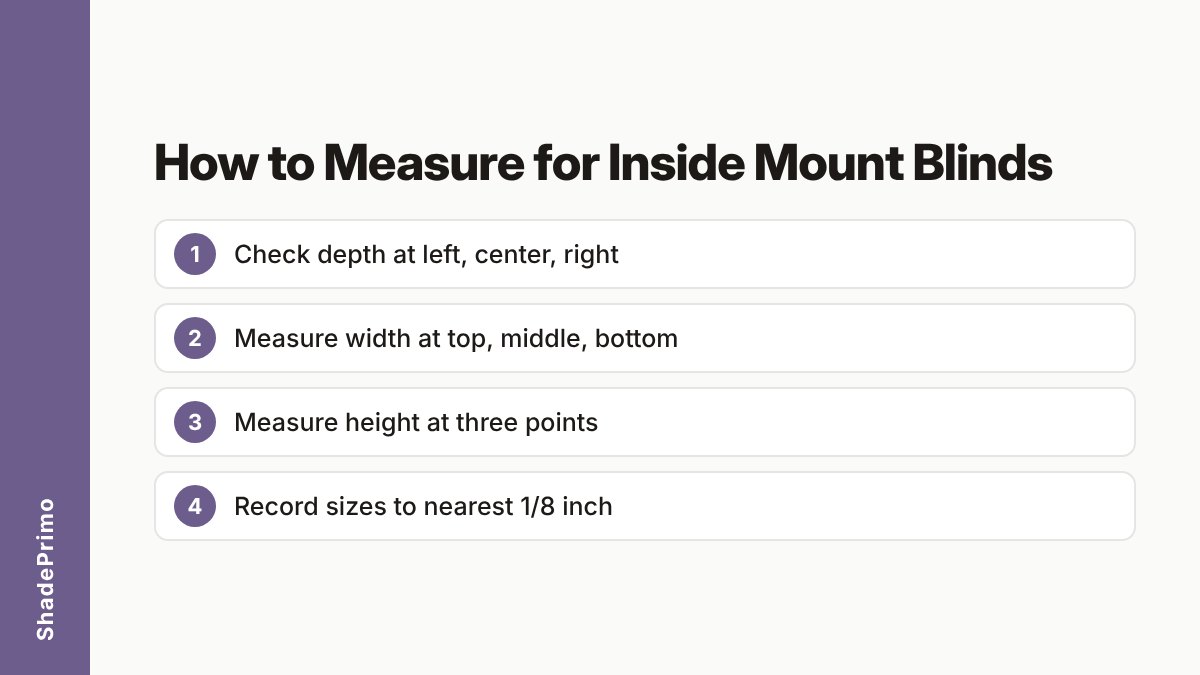
- Check the depth. Measure from the front of the frame opening back to the glass at the left, center and right. Take the smallest reading and avoid window latches or handles that stick out. Compare it with the minimum depth listed for your product.
- Measure the width. Measure from left to right inside the frame at the top, middle and bottom. Use the smallest of the three numbers. Some products, such as roller shades and vertical blinds, only ask for the top width, so follow the maker’s instructions.
- Measure the height. Measure from the top of the opening to the sill at the left, center and right. For most horizontal blinds and shades, use the largest number. For some products, such as vertical blinds and sheer shades, one retailer asks for the shortest reading, so check the instructions for your product.
- Record exact sizes. Write down the measurements as read, to the nearest 1/8 inch (about 3 mm). One major retailer says to enter the exact width and height with no deductions, because the factory applies any needed deductions during production.
- Repeat for every window. Do not copy numbers from one window to the next. Frames that look identical often differ by a small but important amount.
If your tape shows 1/16 inch marks, one retailer suggests rounding width down and height up. Follow the rounding rule given in your own order form if it differs.
A note about light gaps
Inside mount roller shades are built with a small clearance so the operating mechanism can work. One retailer notes this leaves a gap of about 3/4 inch (about 19 mm) on each side. If you want to block more light, an outside mount with extra overlap is a better fit.
How to measure for an outside mount
An outside mount gives you more freedom, because you choose the size you want rather than the size the frame allows.
- Decide where the blind will sit. It can mount on the wall above the window, on the trim, or on the face of the frame. Make sure there is enough flat, solid surface for the brackets.
- Measure the width you want to cover. Measure the full area, then add overlap. One retailer recommends at least 2 1/2 inches (about 6.5 cm) of overlap on each side. A manufacturer guide for horizontal blinds suggests adding 4 inches (about 10 cm) in total to the frame width, and for roller shades adding 3 inches (about 7.5 cm) to the width.
- Measure the height. Start at least 3 inches (about 7.5 cm) above the top of the frame so the brackets and headrail have room. If a windowsill sticks out, measure down to the sill. If there is no sill, measure to at least 2 inches (about 5 cm) below the bottom of the window.
- Record the finished size. For an outside mount, the maker typically builds the product to the exact size you enter, with no adjustments. That means you must add the overlap yourself before you order.
- Check for obstructions. Look for door handles, deadbolts, cranks and thick molding. Some products offer spacer blocks or extension brackets that move the blind forward so it clears these items.
Because the brands above give different overlap figures, treat them as a range and follow the instructions for the product you are buying.
Measuring different blind types
| Product | Inside mount reading | Notes |
|---|---|---|
| Horizontal blinds | Narrowest width, tallest height | Confirm the depth for the headrail |
| Roller shades | Width at the top, tallest height | Needs enough depth and clearance for the mechanism |
| Vertical blinds | Shortest height | Pick the stack side to match how a door slides |
| Interior shutters | Narrowest width, shortest height | Check squareness and room for louvers to rotate |
For shutters, one manufacturer guide also advises checking that the opening is square by measuring the diagonals. If the opening is out of square by more than 1/4 to 1/2 inch (about 6 to 13 mm), an outside mount is the better choice. For an outside mount with trim, it says the trim needs at least 1 1/2 inches (about 3.8 cm) of flat surface.
Common mistakes
- Measuring only once. Windows are rarely perfectly square. Taking three readings finds the tightest point.
- Using a cloth tape. It can stretch and sag. Use a steel tape.
- Subtracting when you should not. If the order form says to enter exact sizes, deducting by hand can leave the blind too small.
- Ignoring depth. A blind that will not fit in the recess cannot be forced. Check the minimum depth first.
- Forgetting handles and cranks. These can stop a blind from sitting flat or rolling freely.
- Assuming matching windows are identical. Measure every window.
- Skipping the return policy. Made-to-measure items are often final sale, so read the policy before you order.
When to call a professional
Consider a professional measure and install if the window is arched or angled, very large, high above a staircase, or if the opening is clearly out of square. Some manufacturers and retailers offer measuring services with custom orders. Special shapes normally follow their own measuring steps, and getting them wrong is costly.
Sources
 Save
Frequently asked questions
Should I measure for blinds inside or outside the frame?
Choose an inside mount if the frame is deep enough and fairly square, because it gives a clean, recessed look. Choose an outside mount if the frame is too shallow, has obstructions such as handles, or you want extra coverage for light and privacy.
Do I need to subtract anything from my inside mount measurements?
Usually not. Several retailers ask you to record the exact opening size and say the maker applies any needed deductions during production. Always read the order instructions for the specific product, because rules differ between brands.
How accurate do my measurements need to be?
Round to the nearest 1/8 inch (about 3 mm) and use a steel tape measure, not a soft sewing tape. Measure every window separately, even if neighboring windows look identical.
What if my window is out of square?
Measure at three points and use the reading that suits your product, then check the diagonals. If the opening is badly out of square, an outside mount is usually the safer choice because it hides the uneven edges.